Elderly Education
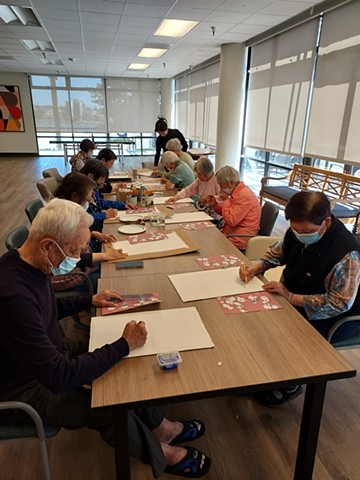
In Oakland, at East Bay Asian Local Development Corporation (EBALDC), a community program reached out to UC Berkeley’s Art Practice community because limited funding made it difficult to hire a paid instructor. They specifically needed a volunteer who could work in both Mandarin and English to serve elders across language backgrounds. I proactively responded and began leading weekly bilingual art sessions, creating an accessible space where both Chinese-speaking and English-speaking older adults could participate to build community through making. Building on that foundation, last winter, I planned and curated a community art exhibition featuring residents’ work, and facilitated intergenerational art-and-story exchanges; I also gathered brief participant reflections to help me learn how accessible, collaborative art-making can relate to emotional well-being, identity expression, and social inclusion to show that arts, culture, and creativity are part of community-building.
Implications and Research Directions
1. Bilingual, community-based art sessions for older adults may support emotional well-being, identity expression, and social inclusion, suggesting that accessible arts programming can be a meaningful site for aging-related learning research.
2. Preliminary participant reflections point to a potential mechanism: collaborative art-making creates shared spaces where linguistic, cultural, and generational barriers become more permeable. This invites further qualitative study on how creative practices shape belonging in multilingual elder communities.
3. The community exhibition and intergenerational exchanges indicate that art engagement may strengthen community cohesion. Future research can examine how sustained arts participation influences social connectedness, cultural affirmation, and healthy aging outcomes in diverse neighborhoods.